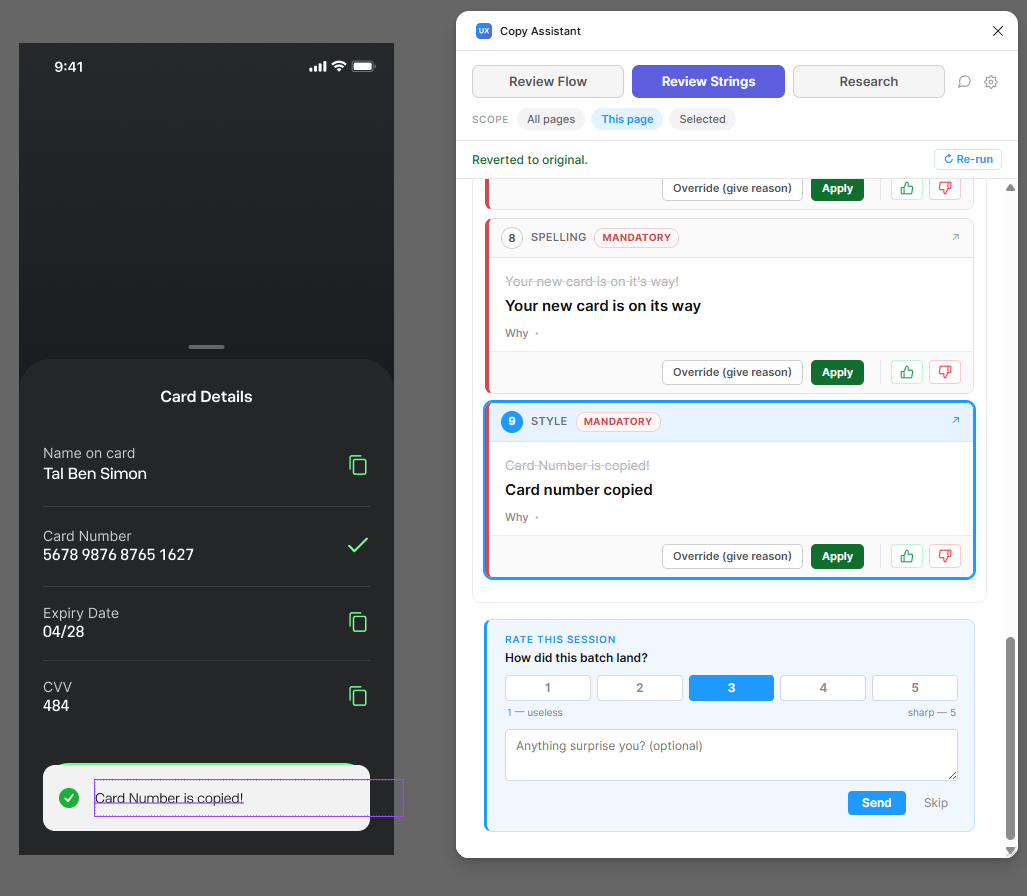
I'm a UX writer, not a developer. I built it by talking.
I've never shipped a Figma plugin, never set up a Postgres database, never written vanilla JavaScript for production. The plugin was built by talking — me describing what I wanted, Claude Code writing the code, both of us looking at the result, me reacting to what was off, Claude Code adjusting.
That's what eToro means when it says "be a Builder." Not the AI builds for you. Not you supervise the AI. It's conversational engineering: the human supplies taste, judgment, and the ability to know when something is wrong without being able to articulate why. The AI supplies the part that's actually hard for non-developers — writing the code, knowing where files live, executing the change without breaking adjacent things. Both halves are necessary; neither is sufficient.
- It grew by accretion, one annoyance at a time. The first version was a single sidebar with a "Loading…" spinner. After the third 90-second wait I asked for parallelization — a worker pool at concurrency eight, progressive rendering, a Stop button wired through an AbortController.
- The feedback infrastructure cycled through three dead paths before landing on the fourth. Power Automate (no Premium license), Cloudflare (eToro IT enforces SSO so I couldn't sign up), Vercel (Hobby tier is non-commercial). Finally landed on Render — Node + Postgres on the free tier.
- The mandatory-rules pass took one session. Claude Code pulled up the style guide JSON and presented every rule one at a time with Mandatory / Suggested buttons. About 30 minutes, 150 rules, 117 mandatory.
- The card redesign happened in 20 minutes. I said the styling looked weird. Claude Code wrote a design brief from first principles, built a side-by-side HTML preview with three states each and a written rationale, sent it back with "sign off before I touch live code." I opened it, said ship it.
What it does
Three tabs — each replacing a piece of the job a single UX writer can't do at company scale.
Tab 1
Review Strings
The words.
Line-by-line review of every string in a Figma file against the style guide. Eight categories: Clarity, Terminology, Tone, Grammar, Spelling, Style, Structure, Compliance. Each finding shows the original string, a suggested rewrite, and a one-click Apply that writes the fix into the Figma frame using the eToro design system's typography.
Tab 2
Review Flow
The sequence.
Flow-level structural audit. Not the words; the sequence. Does each screen have a primary heading? Is there a clear CTA on action screens? Are sibling cards labeled in parallel? Where is structural copy missing?
Tab 3
Research
The naming.
Competitor terminology research. Given a concept ("the action of putting money in"), the agent looks at what major fintech and trading competitors call it (Trading 212, Robinhood, IBKR, Revolut, Coinbase, Bitpanda, Freetrade, IG and more), ranks the industry term by frequency, and recommends a fit for eToro using the style guide.
The editorial-control layer
Some style-guide rules are preferences. Others — Title Case on buttons, no exclamation marks in product UI, regulated financial terms — are firm. The plugin treats them differently.
- 117 mandatory rules replace Reject with Override (give reason). A textarea requires a written justification before the finding can be dismissed.
- 40 suggested rules keep the lightweight Accept / Reject pattern.
- Every override is logged — POSTed to a Node + Postgres feedback backend I shipped on Render. A private dashboard lets me pattern-match where rules get bypassed too often.
That's the part that makes this a content-architecture artifact, not just an AI toy. Editorial control survives the handoff to PMs — and produces data on what to change next.
Where it fits
The plugin is the first concrete piece of the AI-based content system I pitched to the Head of Solutions (~600-person R&D division) in February. The standards I wrote into the style guide are now enforceable in the place where PMs and designers actually work — rather than only at the post-hoc localization chokepoint. It sits earlier in the lifecycle, catching issues at design time before they ever reach a key/value sheet.
The journey from July 2025 to today goes from "here's a mess, let us know when you've fixed it" to a working AI agent that enforces my standards at design time, across the whole org, with editorial oversight and a measurable feedback loop. Built by one person who was told there would be no team.
This is Stop 6 of the eToro story.
⬅ Back to the full content-strategy arc